
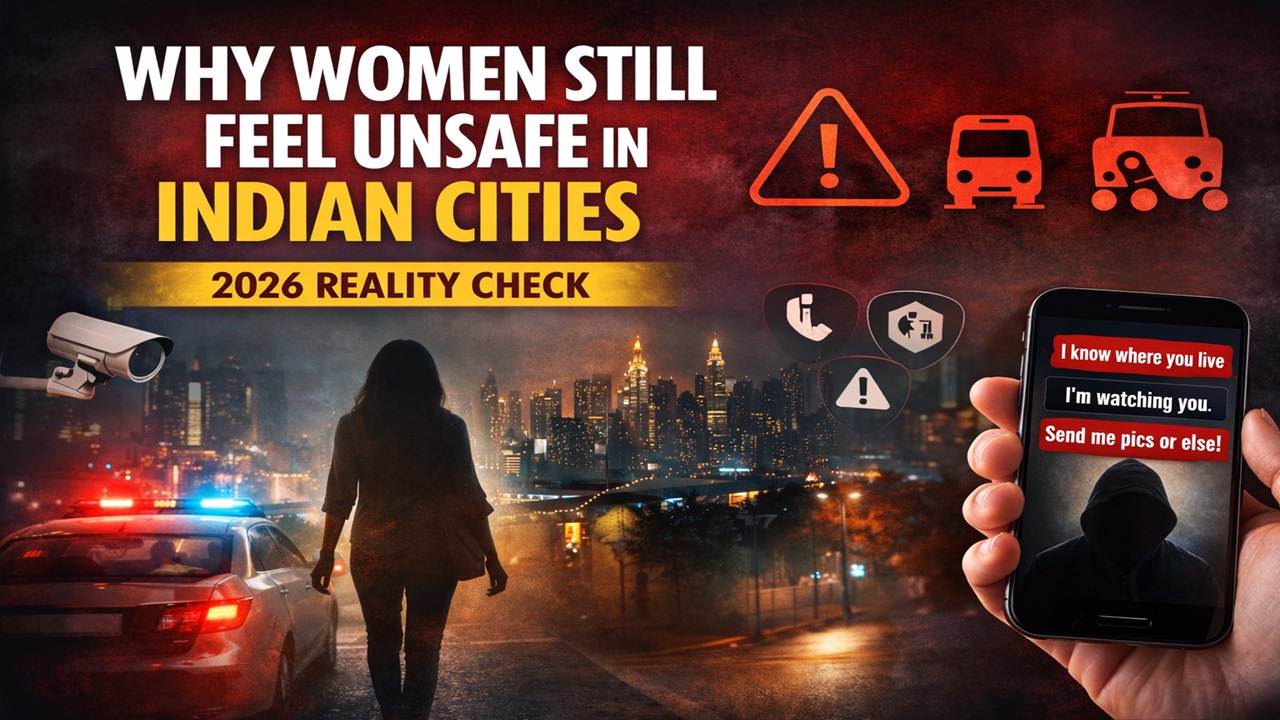
Indian Cities in 2026: Why Many Women Still Feel Unsafe in Urban India
Better roads, expanding metro networks and digital services have transformed urban life, but safety remains a daily concern for many women
New Delhi: Indian cities have undergone a major transformation over the past decade. Metro networks have expanded, roads and public spaces have been upgraded, and smartphones have made travel and communication easier than ever. Yet for many women, navigating an urban environment still involves an uncomfortable calculation: Is it safe to travel alone, especially after dark?
The concern goes beyond serious crimes. Street harassment, unwanted attention, stalking, verbal abuse, unsafe stretches of road and anxiety about travelling alone can all influence how women use public spaces.
A 2025 NARI (National Annual Report & Index on Women’s Safety) survey of 12,770 women across 31 cities found that 40% of respondents described their city as either “not so safe” or “unsafe”. The survey recorded a national safety score of 65%.
The findings underline an important point: modern infrastructure does not automatically translate into a sense of safety for women.
Safety Concerns Often Begin With Everyday Experiences
Not every incident that makes women feel unsafe results in a police complaint.
Unwanted comments, persistent staring, following, inappropriate behaviour on crowded public transport and harassment near educational institutions or workplaces can affect a woman’s decisions throughout the day.
Some women choose different routes to avoid isolated areas. Others adjust their working or travel hours, share their location with family members or friends, or make arrangements to avoid travelling alone at night.
Such precautions may become part of everyday life, but they can also limit how freely women move around their own cities.
Public Transport Has Expanded, But the Journey Does Not End at the Station
Metro systems, buses and app-based transport have become an important part of urban mobility. However, concerns about safety can remain even after a passenger gets off a train or bus.
The last stretch between a transport stop and home can become difficult when roads are poorly lit, streets are deserted or dependable transport is unavailable late at night.
This means public transport safety cannot be assessed only by what happens inside a bus, train or metro coach. The entire journey, including the last mile, matters.
CCTV and Streetlights Are Only Part of the Solution
CCTV cameras, better lighting and emergency systems can improve safety, but their effectiveness depends on how well they are maintained and used.
A camera that is not functioning or whose footage cannot be accessed when needed offers little practical protection. Similarly, installing lights around a transport hub does not solve the problem if surrounding lanes and public spaces remain dark or poorly maintained.
Urban safety requires more than infrastructure on paper. It requires regular maintenance, monitoring and an effective response when something goes wrong.
Fear of Being Blamed Can Discourage Reporting
For some women, reporting harassment can itself feel difficult.
Questions about why a woman was travelling alone, why she was outside late at night or what she was wearing can shift attention away from the person responsible for the harassment.
Such attitudes may discourage women from reporting incidents, particularly when they fear social judgment or doubt that their complaint will be taken seriously.
A safer city therefore requires not only measures to prevent crime but also a system in which women feel confident approaching authorities when something happens.
🔖 Also Read: Eye Stroke: Sudden Vision Loss, Warning Signs and Why Immediate Medical Attention Matters
Police Response Remains Crucial
Cities across India have introduced women-focused helplines, patrol teams and other support mechanisms. However, the experience of accessing these services can vary considerably between neighbourhoods.
The latest available crime data also forms an important part of the wider discussion. The Crime in India 2023 dataset, released through the government’s Open Government Data platform in 2026, provides city-level information on crimes against women in metropolitan areas.
However, recorded crime figures should not be treated as a straightforward safety ranking. Population size, reporting behaviour, police procedures and public awareness can all influence recorded numbers.
In other words, the number of reported cases alone cannot fully explain how safe women feel in a city.
Women’s Safety Now Extends to the Digital World
Safety concerns do not end when a woman reaches home.
Online stalking, unwanted messages, fake social media profiles, threats and image-based abuse have become part of the broader conversation around women’s safety.
As smartphones and social media become increasingly integrated into everyday life, digital security is closely connected with personal safety.
A woman may reach home safely and still face harassment through her phone or social media accounts.
Workplace Safety Includes the Journey Home
For women working late shifts or leaving offices after dark, workplace safety cannot be separated from commuting arrangements.
Employers need to look beyond written policies and formal notices. Reliable transport arrangements, accessible complaint mechanisms and a workplace environment where employees can raise concerns without fear of retaliation are equally important.
A workplace should be considered safe not just within the office premises, but throughout the journey associated with work.
Safety Perceptions Vary From One City to Another
The NARI 2025 survey also highlighted differences in how women perceive safety across cities.
Kohima, Visakhapatnam and Bhubaneswar were among the cities that performed strongly in the survey, while Patna, Jaipur and Delhi were among those recording lower scores.
These findings, however, reflect women’s perceptions of safety, rather than providing a direct comparison of police-recorded crime levels.
That distinction is important. A city with a higher number of reported cases is not automatically more dangerous than a city with fewer reported complaints. Likewise, fewer complaints do not necessarily mean that harassment or unsafe experiences are absent.
What Can Make Indian Cities Safer for Women?
There is no single measure that can solve the problem.
Well-maintained street lighting, functioning CCTV networks, visible policing, dependable public transport and safer last-mile connectivity can all contribute to a safer urban environment.
Equally important are accessible complaint systems, timely emergency responses and a police response that treats women’s concerns seriously.
Schools and colleges also have a role in encouraging healthier attitudes towards consent, respect and harassment. Families and communities can contribute by challenging behaviours that normalise harassment rather than placing the responsibility entirely on women to avoid it.
Women should not have to redesign their daily lives simply to reduce the possibility of encountering an unsafe situation.
A Truly Safe City Gives Women Freedom to Move
Urban development is often measured through new roads, metro lines, commercial centres and technology-driven services.
But there is another measure that deserves attention: Can a woman travel to work, return home, meet friends or walk through her neighbourhood without constantly worrying about her safety?
India’s cities have made significant advances in infrastructure and technology. The next challenge is ensuring that those improvements translate into greater confidence and freedom in everyday life.
A safe city is not one where women are repeatedly told to be cautious.
It is a city where women can move through public spaces without having to live in constant fear.
Disclaimer: This article is intended for general public awareness and discussion of women’s safety in Indian cities. Safety perceptions and crime statistics can vary by city, neighbourhood, reporting practices and methodology. The NARI 2025 findings cited above are based on a survey of women’s perceptions and should not be treated as a substitute for official crime statistics. Readers should refer to government reports and official sources for the latest data.
🟢 Join the VarthaJagath WhatsApp Channel for instant news updates.
🔴 Subscribe to our VarthaJagath YouTube Channel for breaking news, exclusive videos, explainers, and live coverage.
🔵 Follow us on Facebook for breaking news, trending stories, and live updates.
🟣 Follow us on Instagram for news highlights, reels, and exclusive content.
⚫ Follow us on X (formerly Twitter) for real-time news updates and trending conversations.
📱Download the VarthaJagath App to stay updated with the latest news anytime, anywhere.
